
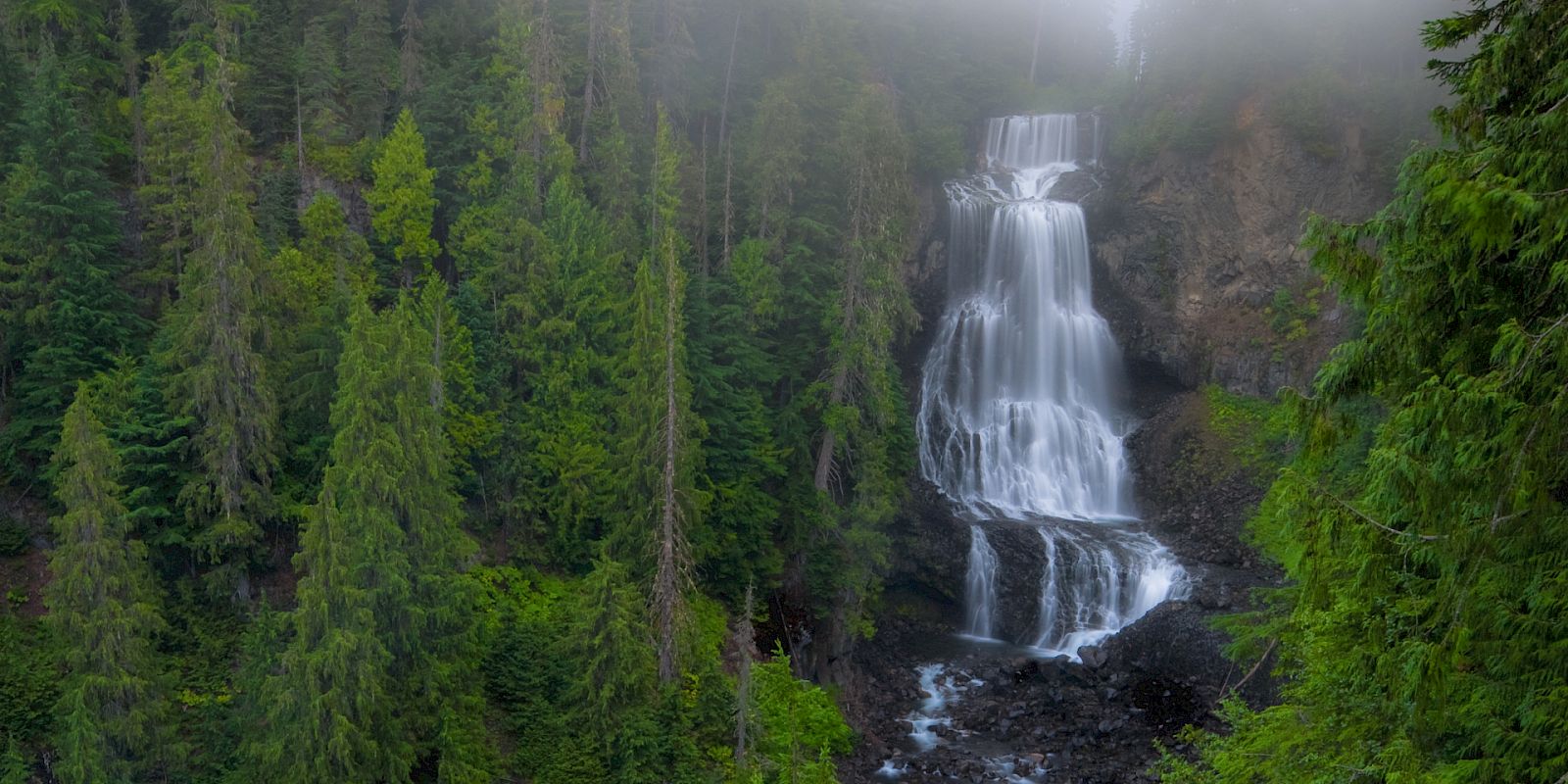
The pristine natural surroundings and untamed wilderness of the Whistler area make visiting the region so unique and special. Whether you are interested in hiking, snowshoeing, photography or casual sightseeing, there are countless ways to get up close and personal with Whistler's flora and fauna.
Whistler is located in the Coast Mountain Range of British Columbia. The top elevation of the Whistler and Blackcomb mountains are 7,160 ft (2,182 m) and 7,494 ft (2,284 m) respectively. The area offers the most reliable snow conditions in the province, with an average annual snowfall of 33.5 ft (10.22 m); however, due to coastal proximity, temperatures are moderate through the winter season, rarely dipping below 12°F (-10°C) in the valley and 5°F (-15°C) in the alpine during the coldest part of the year.
But Whistler isn't just a winter destination. Spring offers comfortable temperatures, refreshing mild rain, and the opportunity to appreciate lush plant life and keep watch for deer and bears in temperate rainforests. Summer promises hot weather, perfect for exploring outdoors and cooling off at glacier lakes in the abundant sunshine. And Fall is the perfect time to hike through alpine meadows and relax in nearby volcanic hot springs while birds soar overhead.
Whistler Area Ecology
Plant Life
Whistler's flora is extensive. Alluvial forest soils are rich in black organic material, high in nutrients and host a dense growth of plants and trees. Whether blanketed in summer sunshine or sparkling winter snow the area is home to an abundance of alpine flowers, evergreen shrubs, ferns, and pine, spruce and evergreen trees, not to mention groves of old-growth and ancient cedar and hemlock that are remarkable to behold. Whistler also has several significant wetland areas.
Wildlife
The Whistler area provides ideal homes for deer, black bears, cougars, marmots, rabbits, birds, and fish. The marmot, a rock-dwelling rodent, is what gave Whistler its name as its shrill whistles warns other marmots of danger. Marmot calls can frequently be heard throughout the mountains.
Numerous bird species from hummingbirds to bald eagles follow a migration path that passes through the Whistler area. In the Winter, bald eagles gather in the nearby Squamish River Valley to feast on salmon. Other birds, including the stellar's jay, ptarmigan and whiskey jack live in Whistler year round.
Whistler Discovery Tours wishes to remind all tour participants that while area wildlife may be spotted frequently by humans and are occasionally curious, they should not be approached or fed. Our guides work to ensure that “bear-smart” precautions are taken during each excursion and advise that feeding birds and other animals leaves them more dependent on human food and garbage and less able to forage and survive in their natural habitat. All animals must be respected.
Natural History
Set in the Coast Mountains, the landscape of Whistler has been carved by the pass between the headwaters of the Green River and the upper-middle reaches of the Cheakamus River. Whistler is flanked by glaciated mountains on both sides. The Garibaldi Ranges are on the side that contains the mountains utilized by the ski resort. On the other side is a group of mountains which are part of the larger Pacific Ranges and are fore-ranges of the Pemberton Icefield.
Glaciers formed this foundation of ancient metamorphic rocks which are between 100 and 200 million years old. Blackcomb Mountain is a ridge of metamorphosed granitic rocks and the town of Whistler is built on strongly layered mica-rich metamorphic rocks.
Whistler Mountain has a top elevation of 7,160 ft (2,182 m) and Blackcomb Mountain has a top elevation of 7,494 ft (2,284 m.)
The area has reliable snow conditions, with an average annual snowfall of 33.5 ft (10.22 m.) Due to coastal proximity, temperatures are moderate through the winter season, rarely dipping below 12°F (-10°C) in the valley and 5°F (-15°C) in the alpine during the coldest part of the year.
Aboriginal Culture
Vancouver and the Coast Mountain Range regions are the ancestral home of the Coast Salish people, including the Squamish, Lil'wat, Sto:lo, Musqueam, and Tsleil-Waututh First Nations bands.
Whistler specifically is home to two native cultures, the coastal Squamish Aboriginal people and the mountain Lil'wat Aboriginal people, whose ancestral territories overlap there. The Squamish Nation territory extends from North Vancouver through Squamish to Whistler. The Lil'wat Nation territory starts in Whistler and extends north to Pemberton to Mount Currie. The nations have traditionally lived together in peace, respecting the land.
Aboriginal culture in the area includes a rich heritage of music, drumming, dancing, and intricate artwork. The First Nations people also had distinct methods of hunting, fishing, and preserving food.
Whistler Discovery Tours is honoured to be able to offer a tour that highlights some of the local aboriginal culture, history, and archaeology.
The first British survey of the area took place in the 1860's. The surveyors named Whistler "London Mountain" due to the heavy fog that gathered in the area. Later, "London Mountain" became "Whistler," thanks to the call of marmots that make the mountains home.
The area attracted trappers, prospectors and loggers who established small camps and four mills in the area in the early 1900's.
In the 1900's, the Rainbow Lodge was built and completion of rail lines reduced the travel time from Vancouver to the Whistler area. The area gained a reputation as a vacation destination. In contrast to the enormous skiing and snowboarding industry in Whistler today, the area started as a primarily summer destination, offering boating, fishing and hiking.
Until the 1960's, the Whistler area was very quiet and even lacked basic infrastructure such as water, electricity, and a road to Vancouver. Then, in 1962, four Vancouver businessmen explored the area and eventually built a ski resort. The Garibaldi Lift Company was formed and in 1966, Whistler Mountain opened to the public. In the 1970's, the Whistler area was incorporated as a Resort Municipality.